Tuesday, November 27, 2012

‘Why I’m Joining the Aam Aadmi Party’

Activist-turned-politician Arvind Kejriwal took the official plunge into electoral politics on Monday, launching his Aam Aadmi Party, the party of the “common man.”

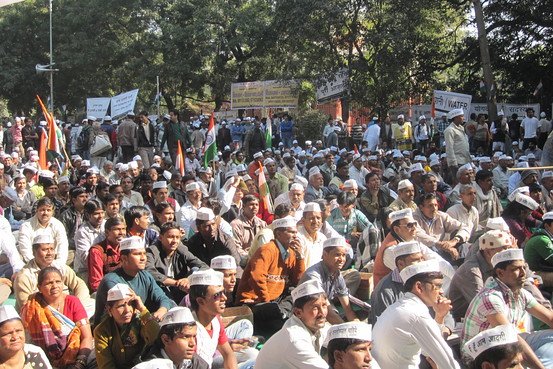
Addressing a crowd of roughly 10,000 people gathered at New Delhi’s Jantar Mantar monument for the launch, Mr. Kejriwal said the Aam Aadmi Party would follow the principle of “swaraj,” the Gandhian concept of self-rule, or rule of the people, and focus on issues that concern common people, like “social inequality, health, education, farmer’s rights and price rise.”


Describing the event as “history in the making,” on Twitter Mr. Kejriwal earlier said his party’s aim was also to “throw out” India’s “corrupt political system.”


Mr. Kejriwal, who announced his anti-corruption movement would turn political in September, added that those present at the public rally “will be treated as founding members” of his party.


The Aam Aadmi Party has two kinds of members: general and active. General members have to work for the party for four months before becoming active members, which would allow them to vote on all important party decisions. The party already has 23 active members, including several of Mr. Kejriwal’s closest associates, like social activist Manish Sisodia and lawyer-turned-activist Prashant Bhushan.


We asked several people at the rally why they decided to join Mr. Kejriwal’s newborn Aam Aadmi Party as “general” members.


Adarsh Kumar, a 38-year-old businessman, came to Delhi all the way from Kotdwara, a town in the northern state of Uttarakhand to show his support for the party. “This party has given us a chance to vote for something we believe in. There is no rhetoric or false promises. It is formed for a cause,” Mr. Kumar said, with reference to Mr. Kejriwal’s anti-corruption crusade. “So far, the fight was through rallies and sit-in-strike. Now, the voice will be heard in Parliament,” added Mr. Kumar.

Like most people at the rally, Mr. Kumar was wearing a Gandhi cap, which Mr. Kejriwal turned into a symbol of his political initiative. The caps, also known as “topis,” were printed with the phrase, “Main Hoon Aam Aadmi,” Hindi for “I am common man.”


Surinder Maini, a farmer from Delhi’s neighboring state of Haryana, described the creation of the party as “possibly a step in the right direction to ward off corruption.”

He said he was joining the party despite having “no expectations” Mr. Kejriwal could challenge established parties like Congress or the Bharatiya Janata Party to become a leading political force in the country. “I’m here to lend my support to the movement, which I feel is the need of the hour,” said Mr. Maini. 


Rajiv Malhotra, a student at Delhi University, said he wanted the party to make its stand clear on issues of development. “I like the idea of forming this people’s party. But it should focus on development. When development happens, corruption will automatically end,” he argued.  

Tauseef Khan, a trader from the northern state of Jammu and Kashmir, said he was “proud to be part of AAP”.

Mr. Khan said he had joined the Congress party last year after its general secretary, Rahul Gandhi, visited his village. At the time, “that was the only party committed to serving the interests of the common man,” said Mr. Khan, who has since changed his mind. “I have been following Kejriwal and his activities and it has finally dawned on me that most of these major political parties are corrupt and exist for their leaders’ existence. So, I have made a shift,” he added.

Anju Rani, a 32-year-old primary school teacher from New Delhi, said she joined the party in the hope that it would give equal representation to women in its ranks, unlike established parties. “This is the right time to join and be part of it,” said Ms. Rani.

Mr. Kejriwal said his party was likely to contest its first election late next year, when New Delhi is set to hold state polls.


Article Courtesy : The Wall Street Journal - India

Wednesday, November 21, 2012

Mother of all Scams - Party Donations

A very interesting front page editorial was recently brought out by Rajasthan Patrika, which talked about the nitty-gritty of how the political funding is undertaken by various political parties.

Anil Bairwal, National Convener of ADR (Association for Democratic Reforms) is of opinion that major political parties do not like to reveal the sources of their donations. According to him the irony is that its mandatory for parties to make public, the source of funds received in excess of Rs 20000/- which they seldom do.

To read this editorial featured in Rajasthan Patrika click here


Tuesday, November 20, 2012

Repeal Draconian Section 66 A of the Information Technology Act, 2008


Our sincere appeal to all of you, kindly forward to all your groups, friends and relatives.

I am sure we want to get rid of this act, which has threatened our very right to freedom of speech.

Its such an irony that whenever a common man speaks up, he's pushed against the wall, where as these politicians can speak anything and everything and get away, why is the Law enforcement, Judicial authorities silent on them and act pro-actively on common man's pain and anguish which comes out through social networking platforms. When will these people (In Power) come to their rightful senses? That's a big question and we the people of India have answers to these questions, just don't sit, wake up and act . Please ..


http://www.activism.com/en_IN/petition/repeal-draconian-section-66-a-of-the-information-technology-act-2008/40495

Monday, November 12, 2012

Gang rape of Mother India: Aseem Trivedi is right after all

With all the scams that have been tumbling out in India one after the other and the government’s blind rejection of any wrongdoing, it would perhaps be appropriate to acknowledge that Aseem Trivedi’s acerbic cartoon ‘The Gang Rape of Mother India’ has captured the spirit of the times. Perhaps, more effectively and certainly more forcefully than what could have been depicted by India’s most popular cartoonist, RK Laxman.

Juxtapose Trivedi’s cartoon with what happened last week and consider the merits of the case: the Manmohan Singh government’s inept handling of the black money issue raked up by activist-turned-politician Arvind Kejriwal, the Comptroller and Auditor General (CAG) Vinod Rai’s observation about the appalling brazenness with which decisions were being taken by the government and the murkiness around the first family of Indian politics as exposed by Janata Party president Subramanian Swamy in the National Herald acquisition case. So far, the Congress has been unconvincing in its defence of making unsecured loans of Rs 90 crore to Rahul Gandhi’s firm, Young Indian.


Aseem Trivedi. PTI

When you put all the scams together, be it the unchecked flow of black money estimated at $462 billion, the Coalgate scam, the 2G spectrum scam, the Maharashtra irrigation scam, the Adarsh Housing Society scam and other such, the feeling that India is being raped and robbed by a nexus of corrupt politicians-bureaucrats-corporates-builders is unmistakable.

Whose vote will Kejriwal cut into, Congress or BJP?

The big question doing the rounds in Delhi’s political circles is who will Arvind Kejriwal damage more – the Congress or the BJP?

Prima facie, it seems like it is the Congress that is bearing the brunt of India Against Corruption’s anti-graft crusade, the latest target being no less than Sonia Gandhi’s son-in-law Robert Vadra.

But with the Delhi elections due next year, and with Kejriwal targeting that opportunity as his first test, the BJP reckons it has something to worry about. Minus Kejriwal, the BJP could have hoped to benefit from Sheila Dikshit’s anti-incumbency. Now, the game is open.


Arvind Kejriwal. PTI


This was evident in the Kejriwal-BJP tussle during the power tariff agitation, where Team Kejriwal’s white Aam Aadmi caps were in contrast to BJP’s black Bijli Andolan.Vijay Goel had a tough time convincing everyone that he had been spearheading the anti-power tariff struggle against Sheila Dikshit all this while.

Goel is, in fact, fighting two battles – one against the public perception that Kejriwal is the real fighter for aam aadmicauses like power tariffs, and the other to convince the BJP leadership that he is the man to take on Sheila Dikshit and lead the party in the 2013 Delhi campaign.

Goel had a faceoff with Kejriwal three days ago and is still feeling the sting. Kejriwal, who was invited to Goel’s anti-power tariff protest, used the opportunity to ask the BJP some uncomfortable questions on the power tariff hike. He achieved his purpose of putting both Congress and BJP in the same bucket.

All’s fair in love or politics, is not it? Goel felt offended when Firstpost asked him this. He fumed: “Kejirwal misused a gentleman’s courtesy extended by me. He came uninvited. It was our stage and our people. He requested me to let him speak for two minutes. I extended the courtesy because my fight is against the Sheila Dikshit government. Any support in this regard is welcome. Instead he blasted us. That’s not fair. He has entered Delhi politics only a few days back. I have demanded an apology from him. I am told that he has responded by saying that I was like an elder brother.”

During his agitation, Kejriwal reconnected the power lines of two people whose power had been cut due to non-payment of bills. Two FIRs have been filed against the persons whose lines Kejriwal connected, but one of them has since paid his dues while the other has not.

Quite clearly, the arrival of Kejriwal has forced both BJP and Congress to wonder who will lose more from his entry, but there is one point of convergence between the two: both blame the media for making Kejriwal a hero to the Delhi aam aadmi.

Party spokespersons believe that if the media stops treating Kejriwal like a celebrity, his fortunes will plummet.

The Congress MP from West Delhi, Mahabal Mishra, a migrant from Madhubani in Bihar, has risen up the ladder by winning three assembly elections and finally a Lok Sabha seat from the Punjabi-dominated constituency. He says: “Let the Delhi elections come, and his bubble will burst. Here the fight has always been a straight one between BJP and Congress. So many parties have tried to succeed in Delhi but none have succeeded. Kejriwal and party can at best cut into the anti-Congress votes, not into Congress votes.”

He shied away from directly saying that Kejriwal will eat into BJP votes and that this will ultimately help the Congress. Many Congress leaders are of the same opinion and believe that Kejriwal will cut into the BJP vote and let Sheila Dikshit win again.

There is also quiet talk about Kejriwal’s relationship with Sandeep Diskshit, Congress’s East Delhi MP and Sheila Dikshit’s son. Sandeep has an NGO background and played the part of an interlocutor during Anna Hazare’s second Jan Lokpal dharna.

A senior functionary of the Delhi BJP echoed similar sentiments on Kejriwal. “He is going to play the role of spoiler or, as they say, `Vote Katua’ in Bihar. For now it looks like he is going to make inroads into the votes that could have come to the BJP and help the Congress. But once the media stops playing him up the way it is doing now, the game will change.”

But a minority view in the BJP is that Kejriwal will help build up the anti-Congress mood and ultimately help the BJP. “There is a distinct possibility that he will help in creating an anti-Congress atmosphere in the city. But when it comes to voting the people will realise that his party is not in a position to win so they will vote for the party which can offer an alternate government – the BJP.”

Voters in Delhi have, on various occasions, proved their unpredictability. Prime Minister Manmohan Singh contested only one election in his lifetime and lost to the BJP’s VK Malhotra in Delhi. Singh’s poll managers had then blamed his loss on some rumors spread against him.

BJP veteran LK Advani managed to win a Delhi seat narrowly against Rajesh Khanna. He subsequently left Delhi for the safer Gandhinagar in Gujarat. Former Minister Jagmohan, who has been considered an able administrator, lost from New Delhi. A Bihari migrant, Mahabal Mishra, to the surprise of many in his own party, won comfortably from West Delhi in 2009.

It won’t be easy for Kejriwal to convert interest into votes since every party needs huge logistical support during campaigning and on polling day. By a rough estimate, one needs 5-7 persons at each polling booth. This means a political party requires, by conservative estimates, about 25,000 workers on polling day in the national capital. Will Kejriwal have that kind of numbers? But then, the reforms introduced by the Election Commission are helping reduce the number of party workers needed to be present at polling stations.

Will Kejriwal have the appetite to hijack the opposition space from the BJP in the long run, as he did the other day with Vijay Goel? The answer to his success in Delhi lies here. His Congress and BJP rivals cite those dwindling numbers at the Mumbai and Jantar Mantar rallies in December last year when Team Anna tried to relaunch the Jan Lokpal movement with yet another fast. This proved to them that Kejriwal without media support can’t muster the numbers.

But neither party is sure who will ultimately benefit from Kejriwal’s gatecrashing their party in Delhi.